
Custom Spring Solutions at Hagens for Industrial Machinery Manufacturers
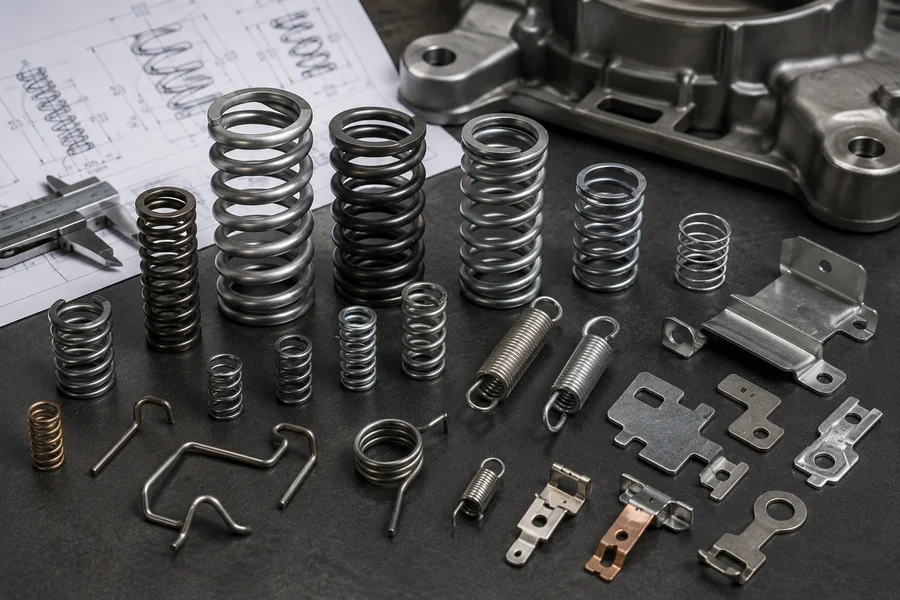
Hagens is a manufacturer of metal components specialising in custom springs and steel stamping parts for industrial applications. When standard spring catalogues fail to meet the dimensional, load, or performance requirements of industrial machinery, Hagens steps in with a project-by-project engineering approach.
- Standard springs frequently cannot meet the dimensional and load requirements of industrial machinery, making custom manufacturing the only viable option in many cases.
- Hagens reviews each custom spring project directly with the customer, designing from a digital catalogue that covers all spring types.
- Hagens produces both custom springs and steel stamping parts under one roof, giving industrial clients a single-source solution for precision metal components.
When Standard Springs Fall Short
Off-the-shelf spring catalogues work well enough for general applications. But industrial machinery rarely fits neatly into standard dimensions. Load ratings, wire diameters, free lengths, and tolerances are fixed in catalogue products. When a machine demands a spring rated for a specific compressive load at a non-standard installed height, the catalogue simply has no answer.
A machine that needs a compression spring with a 14.5 mm outer diameter and a precise spring rate of 3.2 N/mm will not find that in any standard range. The mismatch between what catalogues offer and what machinery actually requires has pushed more manufacturers toward suppliers who can engineer from scratch.
Hagens fills that gap. As a custom spring manufacturer, Hagens designs and produces springs to exact specifications — including unusual dimensions, non-standard materials, and load profiles impossible to source from a catalogue.
How Hagens Approaches Each Project
There is no template. Every custom spring project at Hagens starts with a direct review alongside the customer’s engineering team — covering forces, space constraints, and expected cycle life before any design work begins.
Hagens works from a digital catalogue covering all spring types, including compression, extension, torsion, and wire forms. But the catalogue is a starting point, not a limitation. Each design gets adjusted to match the precise dimensional and performance requirements of the project.
A spring that looks correct on paper can still fail in the field if the designer did not account for thermal expansion, adjacent components, or vibration patterns. Hagens builds those considerations into the design phase. The same engineering rigour extends to their steel stamping parts, giving procurement teams a single supplier for multiple component categories within the same project.
Standard Catalogues vs Custom Manufacturing
The choice between a catalogue spring and a custom-manufactured one depends on whether the standard part actually fits the job — or merely approximates it.
Fit precision is the most obvious difference. A catalogue spring might come within 5% of the required spring rate, which sounds close. In a high-cycle industrial application running 500,000 or more compression cycles per year, that 5% gap compounds — leading to premature fatigue, inconsistent machine behaviour, and unplanned downtime. A custom spring matched to the exact load and dimensional envelope removes that risk at the source.
Standard springs are produced in common materials like music wire or stainless steel 302. If an application involves corrosive environments, extreme temperatures, or unusual magnetic requirements, the material itself needs to be specified alongside the geometry.
Lead time is where standard catalogues hold an advantage — off-the-shelf springs ship immediately. For final production builds where reliability is non-negotiable, however, waiting for the right part is cheaper than replacing the wrong one.
Stamping Parts in the Same Portfolio
Many assemblies also call for stamped metal parts with tight tolerances and specific material properties. Hagens produces stamping parts — including brake wear indicators, screw terminals, and building industry components — to tolerances suitable for safety-relevant and structurally loaded applications.
One qualification process, one quality standard, one point of contact — reducing the risk of tolerance mismatches between components from different vendors.
Which Solution Fits Which Application?
If your machine requires a spring with non-standard dimensions or a load rating outside catalogue ranges, custom spring manufacturing is the direct answer. If your assembly includes stamped metal components that must hold tight tolerances in long-term installations, stamping parts belong in the conversation.
Many industrial machinery builds need both. A single gearbox housing might require custom compression springs for valve control and stamped terminal connectors for the sensor array. For industrial machinery manufacturers working outside the boundaries of standard catalogues, Hagens offers a direct path to components built around the actual requirements of the application.